Meeting recap benchmark for client reporting services
 Gabriel Tan
Founder and Strategy Lead · AIGP (IAPP) · Lean Six Sigma Green Belt
Gabriel Tan
Founder and Strategy Lead · AIGP (IAPP) · Lean Six Sigma Green Belt

A managing director I work with told me last week that one of my consultants writes the best meeting recaps she has seen.
She was frustrated. Her own team had the same tools. Gemini running on Google Meet. Claude available for formatting. Otter on standby. But her consultants were still sending recaps that read like transcripts with a header slapped on top. She had stopped reading them. The clients had stopped responding to them.
I told her the truth. My consultant's recaps are about 60 to 70 percent of the way there when they land on my desk. They are not perfect. But they are good, and they are good because of the sequence she follows, not the tools she uses.
The meeting recap is one of the most visible client reporting services any agency delivers. Get it wrong week after week and the client stops paying attention. Get it right and the client treats it as evidence the agency is on top of the account.
Here is the sequence.
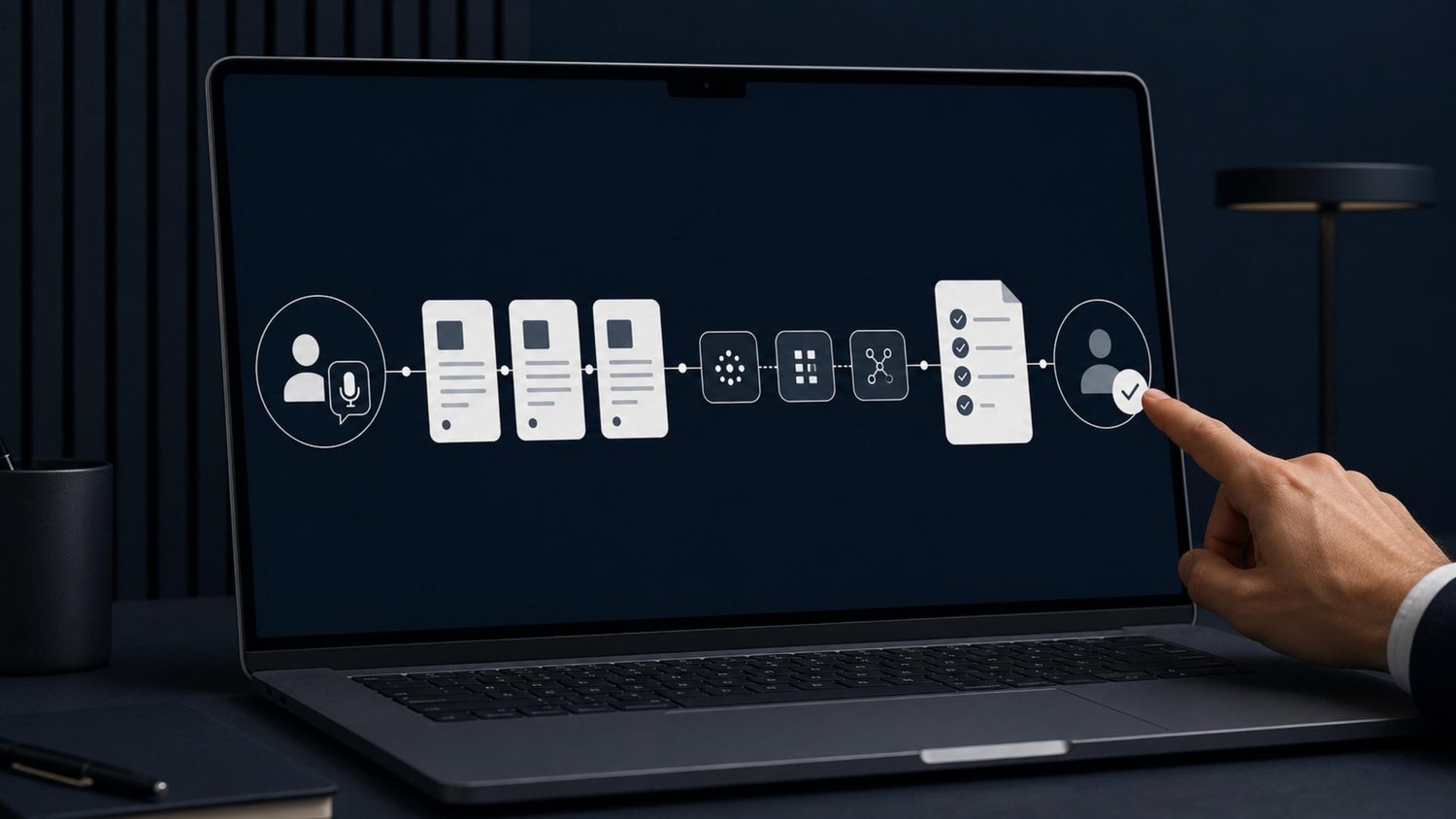
1. She joins the meeting on Google Meet with Gemini transcription running. That is the safety net, not the primary source. While the meeting runs, she takes her own notes. Separate window. Her own words. The act of deciding what to write down is the act of listening.
2. After the meeting, she pulls the Gemini summary alongside her notes. She writes the recap from her notes first, then checks the transcript for anything she missed. The recap is her interpretation of what happened, not a reformatted transcript.
3. Every recap follows the same five-field structure. Objective: what the meeting was called to address. Discussion: the key points raised, in order of weight. Decisions: what was agreed, stated plainly. Next steps: what happens now, with deadlines. Ownership: who is responsible for each action, by name. If a field is empty, it means either nothing was decided or the junior was not listening closely enough. Both are useful signals.
4. She sends it to me. I read it and mark the two or three things her experience level does not yet let her catch. The comment the client made sideways that turned out to be the real concern. The decision that was implied but never stated. The action item everyone assumed someone else would handle.
5. She edits. Then it goes to the client. Within 24 hours of the meeting, every time.
Three layers. The tool captures the words. The junior captures the meaning. The senior catches the gaps. Each layer does a different job.
The recaps that frustrate MDs are usually missing the second layer. The junior never built the habit of listening and interpreting. The tool made it easy to skip that step, and nobody set up the process to prevent it. That is the agency client reporting weakness most communications firms tolerate without noticing what it costs them.
Set the rule: no recap goes to the client without the junior writing it from their own notes first, structured against those five fields, and the senior reviewing it for what is missing, not for grammar.
How does your team produce meeting recaps right now, and who checks them before the client sees them?
Gabriel Tan is the founder of Mekong Bridge Advisory. He builds structured execution systems for PR and communications firms.
info@mekongbridge.com| www.mekongbridge.com