PR workflow: cut talking points from two hours to 30 minutes
 Gabriel Tan
Founder and Strategy Lead · AIGP (IAPP) · Lean Six Sigma Green Belt
Gabriel Tan
Founder and Strategy Lead · AIGP (IAPP) · Lean Six Sigma Green Belt
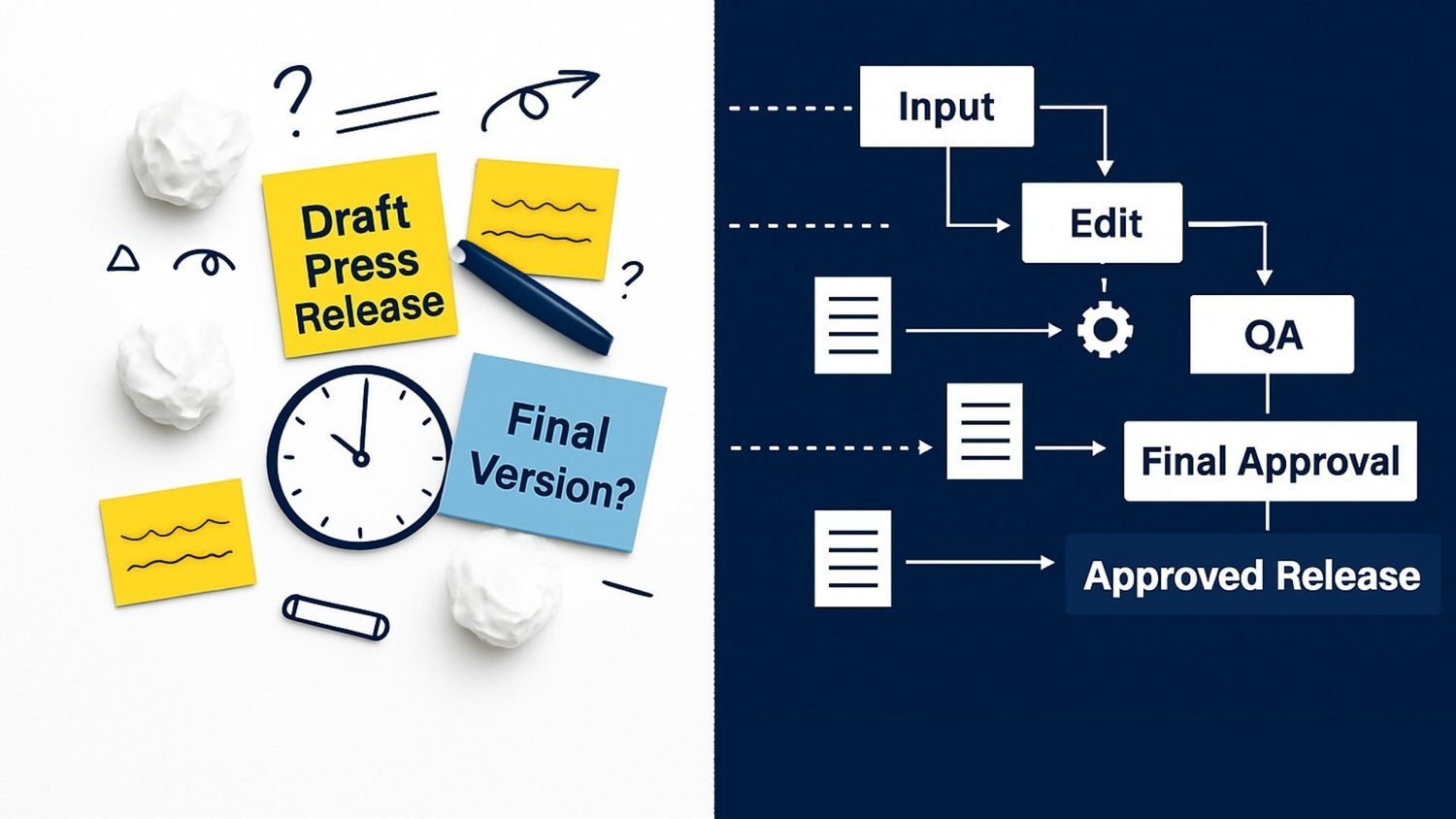
When a journalist sends a question for a spokesperson, most communications firms handle it the same way. The associate researches the topic manually, looks up past positions, and writes talking points from scratch. Each set takes one to two hours. Quality varies depending on who drafts it and how rushed they are.
The senior often ends up writing it themselves because explaining what good looks like takes longer than doing it. That is senior time, the most expensive resource in the firm, spent on a task that should run on a system.
A well-run executive media brief at a PR agency takes 30 minutes. Here is how to build it.
Strip the task into what it actually requires
Before redesigning anything, ask: what does a talking points document actually need as inputs? Not "research and writing." Break it down further.
A talking points document needs exactly four things:
1. The journalist's question and context (who is asking, which publication, what angle, any special requests).
2. The latest authoritative news and the firm's house view on the topic.
3. The spokesperson's past positions and talking points on the same or related subjects.
4. A style and format standard that defines what the finished document looks like (answer length, prose structure, data citation rules, spokesperson voice).
Most firms have none of these stored as reusable files. Every query starts from zero. The associate rebuilds all four inputs every time. That is where the two hours go.
Build the two reference files that do not exist yet
Of the four inputs, the first three change with every query. The journalist's question is new each time. The latest news is current. Past positions depend on the spokesperson and topic.
But the fourth input, the style and format standard, should be built once and reused permanently. This is the file that is almost always missing.
Pull eight to ten approved talking points documents your firm has produced in the past 12 months. Lay them side by side. Look for what is consistent across the ones approved without major edits.
Look for patterns in five areas:
Answer length. How long is a typical answer? Most firms land between 250 and 500 words per question.
Prose structure. Flowing paragraphs or bullet points? How many paragraphs per answer? Is there a standard opening pattern (direct answer first, then context)?
Data citation rules. Statistic or market figure: source named inline, footnote, or standard qualifier phrase ("according to," "based on," "per")?
Spokesperson voice. First person or third person? Technical or conversational? Phrases the spokesperson naturally uses or avoids?
Qualifier and hedge phrases. What standard phrases does your firm use when the position is not definitive? ("We are monitoring," "our current view is," "based on available data.")
Write it all in one document. This is your style and format guide.
The second reference file is an anti-AI checklist. If your associates use AI to help draft, the output carries patterns that sound generated: em dashes in every sentence, trailing analysis phrases ("reflecting a broader shift in"), promotional adjectives, uniform sentence length. The checklist gives the associate specific patterns to find and rewrite before the senior sees the draft.
Both files sit inside the project. They do not change from query to query. Build them once, maintain them quarterly. This is the agency workflow process the task has been missing.
Define the six-step sequence
Once the reference files exist, the task follows a defined sequence every time.
Step 1: Log the question. Spokesperson's name, topic, publication, deadline, any special requests. Two minutes. Prevents the "wait, which journalist asked this?" confusion that wastes time later.
Step 2: Research. Pull the latest authoritative news and the firm's house view. AI assists; the associate verifies. Three to four recent and credible sources. Note the firm's stated position if one exists.
Step 3: Past positions. Search for the spokesperson's previous talking points on the same or related topics. The new brief must be consistent with any public position. If the position has changed, flag for the senior before drafting.
Step 4: Draft against the format guide. Answer length, prose structure, citation rules, spokesperson voice. The guide removes guesswork. The associate is not deciding what the document should look like. They are following a defined standard.
Step 5: Anti-AI pass. Run the draft through the anti-AI checklist. Find and rewrite any patterns that sound generated. Five minutes. The difference between output that reads like AI wrote it and output that reads like the spokesperson said it.
Step 6: Human QA. Before anything goes out, a human reviews for what AI cannot judge: key names spelled correctly, key numbers verified, overall read and tone. The senior sees the output here. Their role is approval, not editing.
What changes after this is built
Before the system, each query started from zero. The associate spent most of their time figuring out what the document should look like while also researching and drafting. The senior often took over because the gap between the associate's output and the required standard was too wide to bridge through edits.
After the system, the associate follows the sequence. The reference files bridge the gap between the standard and what the associate can produce. The senior reviews and approves. Total time: 30 minutes.
At four to six queries per week, that is 6 to 9 hours of junior time recovered and 2 to 3 hours of senior time returned to advisory work. Weekly. From one workflow. That is how PR agencies protect senior time at the point where it is most expensive.
How to apply this to any repeatable task
The method is the same regardless of the task. Ask three questions.
What does this task actually require as inputs? Break it further than "research and writing." List every distinct input the finished product needs.
Which of those inputs are we rebuilding from scratch every time? Those are your reference file candidates. Build them once.
What is the sequence? Define the steps, put AI scaffolding where it helps, and put human QA at the end.
The question is never "how do we do this faster." The question is "which inputs are we rebuilding from scratch every time, and can we build them once?" In almost every repeatable task we have audited at communications firms, the answer is the same: most of them.
Pick one task in your firm. The one your senior does themselves because it is faster than explaining what good looks like. Strip it into its inputs. Find the reference files that do not exist. Build them. The speed problem solves itself.
Gabriel Tan is the founder of Mekong Bridge Advisory. He builds structured execution systems for PR and communications firms.
info@mekongbridge.com| www.mekongbridge.com