How to audit an agency workflow in one day
 Gabriel Tan
Founder and Strategy Lead · AIGP (IAPP) · Lean Six Sigma Green Belt
Gabriel Tan
Founder and Strategy Lead · AIGP (IAPP) · Lean Six Sigma Green Belt
Every communications firm has at least one creative agency workflow that everyone knows is painful but nobody has sat down to fix. The monitoring report that takes three hours when it should take 90 minutes. The newsletter that needs four rounds of edits every month. The press release process where the senior rewrites the junior's draft from scratch because it is faster than giving feedback.
The pain is obvious. What is less obvious is how to fix it without a consulting engagement, a new hire, or a software purchase. The answer is a workflow audit: a structured method for finding where time and quality are leaking, and building the system that closes the gap.
Here is how to audit one workflow in your firm. The whole process takes a day. You can do it this week.
Pick the workflow
Do not audit everything at once. Pick one. The right one to start with is the task that meets two criteria: it runs frequently (weekly or more), and it causes visible frustration among your team.
If you are not sure which one, ask your MD: which repeatable task causes the most frustration or consumes the most senior time? MDs feel the pain at the top of the chain. They see where their own hours go and where client complaints cluster.
Do not pick a task because it seems like the most broken. Pick the one the MD feels most. Buy-in matters more than severity when you are doing the first audit, because the results need to land with the person who approves changes to how the team works.
Talk to three people
A workflow audit needs three perspectives. Each one reveals something the other two cannot.
The MD or senior leader gives you priority and context. Ask: what is this task supposed to achieve? What does a good output look like? How often does the output miss the mark? Where do you end up spending your own time on something a junior should handle? The MD tells you what the standard is and where it breaks.
The senior practitioner gives you the editorial and quality standard. Ask them to walk you through how they do the task when they do it themselves. Step by step. How long each step takes. Where they make judgment calls. Where they catch errors. What they fix most often in junior work.
The junior gives you the gap. Ask them to walk you through how they do the same task. The version they actually follow on a busy day. Where they get stuck. Where they are guessing. What instructions they wish they had. What reference materials they look for but cannot find.
The three conversations usually take 30 to 45 minutes each. You can do all three in a morning.
Compare the three perspectives
Lay the three accounts side by side. You are looking for three things.
Where the standard exists but is not being followed. The senior knows the press release header should read like a broadsheet headline. The junior does not know this because it is not written down anywhere. The standard is in the senior's head. It has never been turned into a reference file.
Where the standard does not exist at all. Nobody has defined how long the monitoring report should take, what format it should follow, or what QA checks happen before delivery. Each person does it their own way. Quality depends on who is working that day.
Where the SOP exists but does not match reality. The firm has a written SOP for newsletters, but the junior skips three steps because they are time-strapped, and the senior has never enforced the sequence. The SOP is a document, not an agency workflow process.
Almost every audit produces the same finding. The standard exists in the senior's head but not in a reference file. The junior is guessing. The senior fills the gap with their own time.
Break the task into its smallest steps
Take the workflow as described and break it into individual steps. Not categories like "research" and "drafting." Actual steps.
For a monitoring report, the steps might be: set up keyword searches, export data, clean and format the data, write the executive summary, add client-specific context, format to the client's template, run QA checks, submit for senior review.
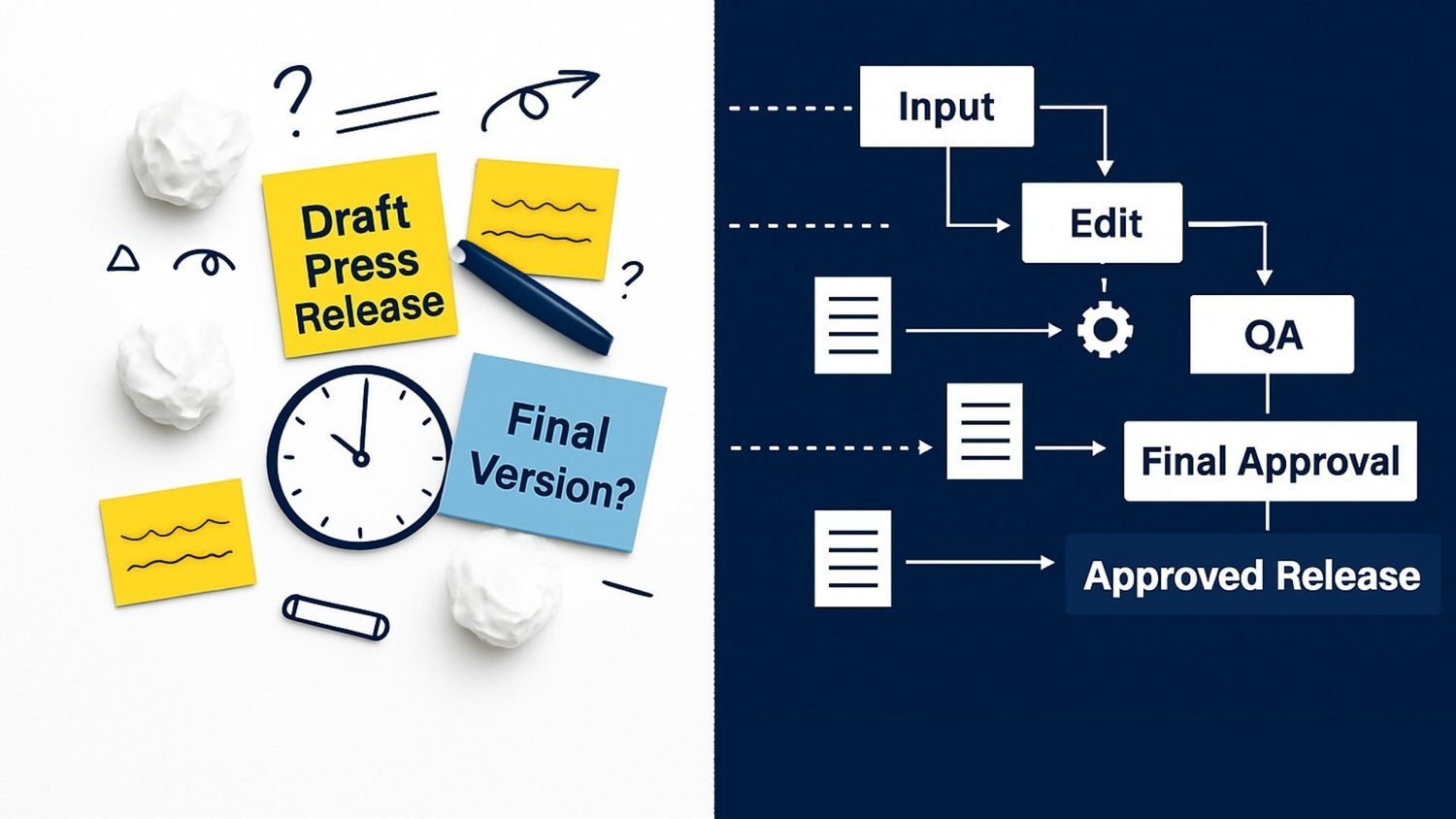
For a press release: receive the brief, generate a client update (current positioning, market context), draft clarifying questions, develop the headline and subheadlines, draft the body, draft the executive quote, run the anti-AI checklist, run the QA checklist, submit for senior review.
Write each step on a separate line. Note who currently does it, how long it takes, and whether a reference standard exists for that step.
For each step, ask one question
Does a reference standard exist for this step?
If no, build it. Work with the senior to define what good looks like for that specific step. A format template. A brand voice guide. A checklist. A set of rules the junior can follow without asking the senior every time.
If yes, ask whether the junior can follow it without help. If the standard exists but the junior still gets it wrong, the standard is either too vague, too hard to find, or not connected to the actual workflow. Fix the bridge: load the reference file into the AI project, convert the standard to a checklist, or add an AI-assisted step that scaffolds the junior's output to the standard.
The sequence at the end is always the same: human starts the task, AI provides scaffolding at defined points, human reviews and approves at the end. Human, AI, human.
Build the missing pieces
By this point you have a list of steps, a note on which have reference standards and which do not, and a clear picture of where time and quality are leaking.
For each step that lacks a reference standard, create the reference file. For each step where the standard exists but is not being followed, make the standard easier to follow.
Combine everything into one SOP. Structure it in the order the junior follows it. The SOP should read as a sequence the junior can work through from start to finish without asking anyone for help. This is the working version of a PR agency SOP template for communications work.
Add the QA checklist as the final section. Every factual, formatting, and quality item the junior must verify. The junior does not submit until the checklist is complete.
Test it once
Have the junior run the next instance of this task using the new SOP. Hand them the SOP and ask them to follow it step by step.
Review the output. If the senior still needs to rewrite, something in the SOP is missing or too vague. Ask the junior where they got stuck. Ask the senior what they had to fix. Update the SOP.
Within two to three iterations, the SOP stabilises.
What one audit typically finds
A single workflow audit, done properly, typically recovers 5 to 15 hours per week from one task. The range depends on how often the task runs and how much senior time was being consumed by rework.
On quality, the improvement is immediate. The first draft that follows a defined SOP with reference files and a QA checklist is closer to the standard than any draft produced without those tools.
The compounding effect matters more than the first result. The second audit takes half the time. The pattern is familiar. Three to four audits later, the firm has a production system. The senior's time shifts permanently from production supervision to advisory work. That is the cumulative effect of an AI workflow audit on a PR agency, run task by task.
Start with one workflow this week
Pick the task your MD mentions most. Book three 30-minute conversations: MD, senior, junior. Compare the three perspectives. Break the task into steps. Find the missing reference files. Build them. Write the SOP. Test it once.
One day of work. The hours come back every week after that.
What is the one workflow in your firm that everyone knows is painful but nobody has sat down to fix?
Gabriel Tan is the founder of Mekong Bridge Advisory. He builds structured execution systems for PR and communications firms.
info@mekongbridge.com| www.mekongbridge.com